



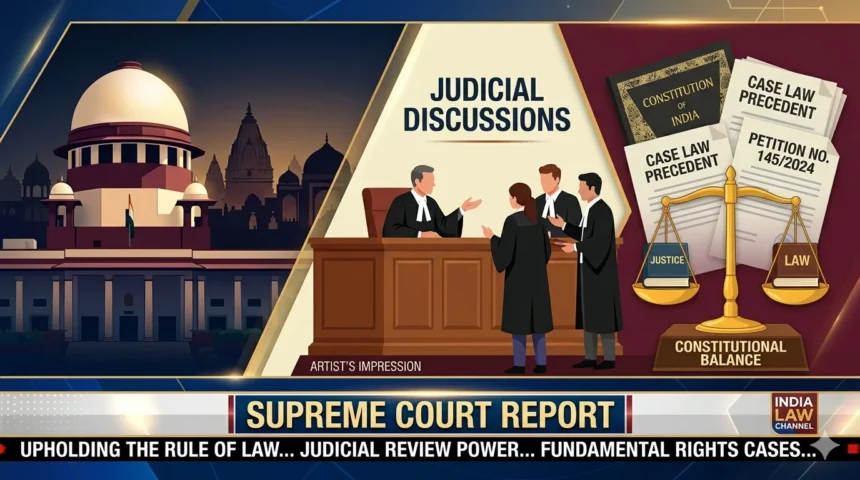
Sabarimala Case Under Spotlight Again – Can the Judiciary Determine What Is “Superstition”?
The apex court of India has stated that it can question what amounts to “superstition” under a particular religion while deliberating on the Sabarimala issue, which is currently being challenged by the government of India.
This statement has brought the contentious issue to the limelight once again, posing fundamental questions regarding the boundaries of judicial scrutiny in religious affairs.

Immediate Consequences
- Intensification of legal/constitutional controversy.
- Gaining attention from media/politicians.
- No impact on market movements; strong policy implications.
Policy decisions often tend to have more of an effect than market movements in such cases.
Ruling of the Supreme Court
The court has made it clear that:
- Jurisdiction to evaluate religious practices exists.
- Practices can be examined against the Constitution’s provisions.
- ‘Essential religious practice’ can be defined and scrutinized.
This shows that the interpretation of judicial supervision over religion is wider.
Centre’s Position
The position adopted by the Union government in opposition was that:
- Courts should not be involved in defining religions beliefs as superstition.
- Practice of religion comes under the ambit of religion.
- Intervention through judiciary should be kept in check.
There emerges a legal dispute between constitutional construction and the freedom of religion.
Legal Perspective
The case at the heart of the matter is replete with issues relating to the constitution.
- Can courts decide on the essence of religion?
- What should be the demarcation between religion and constitutional rights?
- What is the extent of judicial intervention in matters of religion?
The ruling may have consequences for other legal issues revolving around religion.
Expert Opinion
Experts opine that the case is likely to create precedents for future legal disputes.
“This is not just about one temple, but about how courts intervene in the matter of religion in India,” says a constitutional expert.
This verdict will set precedents for future cases.
Contextual Background
The Sabarimala dispute continues to be a topic of interest in terms of issues pertaining to:
- Gender rights and equality.
- Religious practices and customs.
- Constitutional provisions.
One of the cases that involves conflict between religious practices and fundamental rights has continued to generate keen interest among analysts for quite some time.
What To Watch For?
- Final remarks by Supreme Court judges.
- Centre’s defence of the case.
- Future implications of the decision.
- Reactions from people and politicians.
Broader Implication
The critical question at hand today is:
Will the judiciary assume an expanded judicial role in matters of religion or reduce its influence?
This would have major implications for the dynamic interaction between law, religion, and fundamental rights in the country.
To any outside observer, this goes beyond being a mere legal issue.
This represents a watershed for understanding how a constitutional democracy adapts to change.
Note:
This write-up is for reference purposes only and does not contain any legal advice. Interpretations of law are open to judgment and are liable to change.
Reviewed for accuracy and last updated on April 8, 2026.