



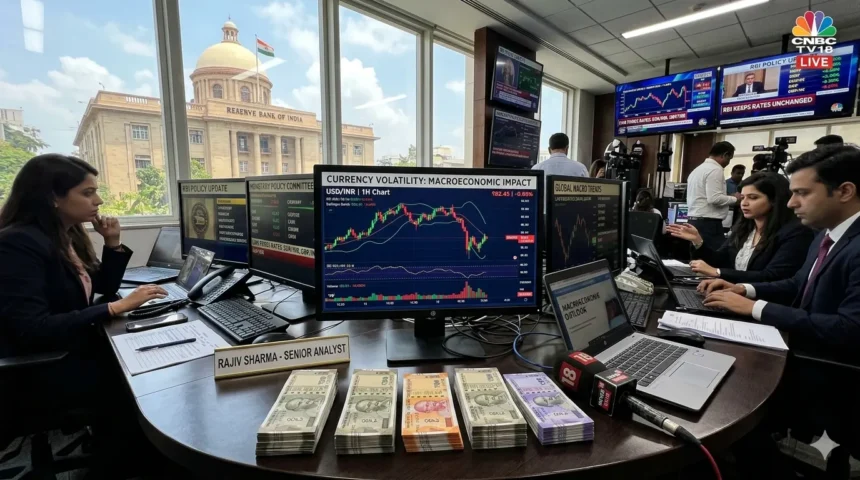
Is the RBI Changing Its Strategy? Rupee Stability Could Be Preferred Over Liquidity
The Reserve Bank of India might be inclined towards rupee management rather than abundant liquidity, Tanvee Gupta Jain states.
The opinion comes from a new macroeconomic situation when currency stability becomes one of the main priorities amid uncertainties in the world economy.

Immediate Implications for Markets
- Forex will probably get indications of more aggressive RBI involvement.
- Yield levels on bonds might react to hints of tighter liquidity stance.
- The stock market, like Nifty 50 index, would follow external signals.
Whenever a monetary strategy focuses on currency aspects, many asset categories feel its effect at once.
Why Does It Matter?
Management of rupee volatility is important since:
- Sudden fluctuations affect imports expenses (especially oil).
- Export competitiveness can change quickly.
- Foreign investors’ attitude is dependent on rupee stability.
Under conditions of uncertainty in the world economy, priority is usually given to stability over growth.
Supply-Demand Perspective
The change in policy would affect liquidity management as follows:
- Constrained liquidity → would help stabilize the currency.
- Too much liquidity → could lead to instability of currency in times of stress.
- RBI’s role → would ensure that supply and demand are equal in foreign exchange markets.
This implies a compromise between growth management and currency stabilization.
Analysis
Financial experts opine that such a strategy would take into account the changing scenario.
“In a highly uncertain global landscape, it is essential to manage currencies well to preserve financial stability,” said Tanvee Gupta Jain.
Such tactics are usually employed when external threats prevail over domestic growth prospects.
Overall Picture
The current scenario consists of the following factors:
- US dollar strength.
- Global capital volatility.
- Geopolitical tensions impacting the economy.
Currencies of emerging economies like the rupee are especially affected by these aspects.
What Traders Need to Monitor
- Actions by the RBI in foreign exchange markets.
- Trends in the INR versus the US dollar.
- Liquidity measures within the banking sector.
- Yield curve developments.
- Foreign central bank policies.
Greater Significance
Given the changing perspective of the RBI, the critical issue is:
Is currency stability now the overriding concern for India’s macroeconomic policy framework?
This is due to the fact that central banks influence markets in terms of priorities.
In this context, the important implication for traders is:
The INR will no longer be considered peripheral; rather, it may dictate market moves.
Disclaimer:
This post is strictly informative and should not be considered investment advice. Currencies and financial markets are fraught with various risks. For investment advice, readers should contact professional financial advisers.
Reviewed for accuracy and last updated on April 7, 2026.