



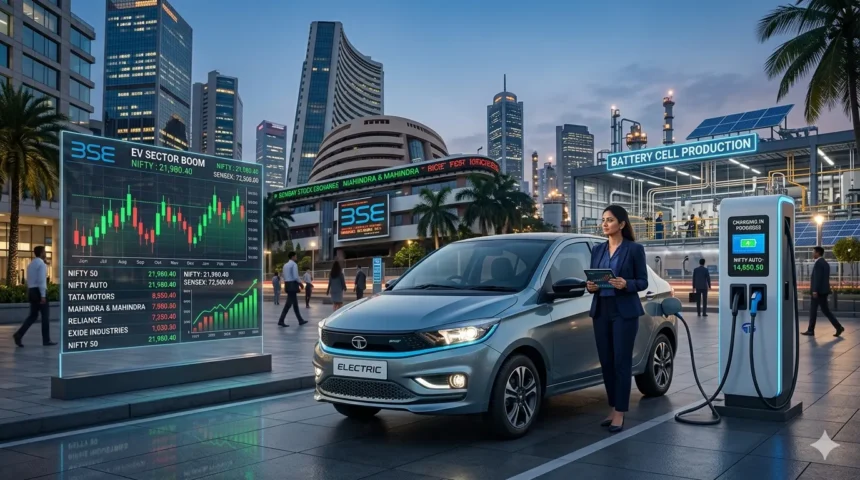
Best EV Stocks India, The emergence of India’s EV story is not just a futuristic phenomenon anymore. From what once started out as a niche investment theme among the early adopters has now developed into a mainstream investment theme. This has been propelled by government policies, increase in fuel prices, better charging facilities, and technological advancements in the sector. The ironic thing about EVs is that although many investors look towards the manufacturing companies of the cars themselves, the largest beneficiaries may very well be those that manufacture batteries, automobile components, and charging stations. As the Indian capital markets enter a phase where investors are looking out for investment themes with long-term structural growth, EV stocks have emerged as one of the most-watched stocks for 2026.
Why does it matter?
There is a mobility revolution taking place in India currently. Based on data from the Indian government and the industry, the adoption rate of electric vehicles (EVs) is consistently increasing for various types of vehicles, especially electric two-wheelers and commercial vehicles. The broader investment market scenario of 2026 has also led to heightened interest in investing in industries related to manufacturing, energy transition, and domestic consumption. The PLI scheme, battery manufacturing incentives, and localization efforts have led to massive investments being made by corporates into the EV ecosystem. As a retail investor, one needs to be able to pick out the stocks that will make the most of this trend while avoiding overvalued growth stocks. Unlike previous thematic trends, the opportunities available in the EV sector are not just limited to speculative and growth stocks anymore. Several traditional companies listed on the NSE & BSE have substantial revenue contributions from the EV sector itself.

The best way to invest in EV stocks in India would be through some of the existing auto manufacturers who have already managed to build economies of scale, distribution, and production capabilities. Tata Motors has always been a stock to watch in terms of EV investments. Tata Motors has maintained its dominant position in the Indian passenger electric vehicle industry due to vehicles like the Nexon EV, Tiago EV, Punch EV, and Curvv EV. Even though there may be fluctuations in market share due to increased competition, it is an important name in moving towards electric vehicles. It should be noted that the case for investing in Tata Motors goes far beyond just EVs because it also produces commercial and luxury vehicles under the Jaguar Land Rover brand.
Yet another player that is making headlines is Mahindra & Mahindra. The company has invested heavily in electric SUVs as well as dedicated EV architectures. The key point about the company is its strategy of combining the popularity of its brand with newer and more advanced electric vehicles. For many analysts, the push towards electric vehicles for Mahindra is more about growth than earning potential in the near term.
TVS Motor Company is yet another important player. The competition within the electric two-wheelers sector has become fierce, but TVS Motors gets the benefit of having a strong dealer channel as well as strong brand equity. The TVS iQube has emerged as a notable model within India’s electric scooters segment. Bajaj Auto has added muscle to its EV segment through its new platform Chetak. If investors are interested in diversification for their listed two-wheeler investments, then TVS Motor Company and Bajaj Auto are good options.
In terms of regulation, it will be important for investors to check information disclosed by the company through their stock exchange filings at NSE and BSE websites. The Securities and Exchange Board of India mandates that companies listed at exchanges need to disclose important information to assist investors understand the growth potential and risk factors associated with investment in these firms.
The rationale for investing in battery firms is rather clear-cut. Every EV needs batteries, battery packs, management technology, and charging technologies. Even in a scenario where competition between EV car brands becomes more severe, there could be an increase in demand for the products above. Put differently, battery firms stand to gain irrespective of whose brand emerges victorious.
Component producers in the automotive industry are also worth considering. These include component makers manufacturing products such as motors, electronics, wiring systems, powertrain components, and precision engineering products. Some firms in this group such as Bosch India and certain listed component producers have indicated electrification opportunities in their discussions with investors. Not every component firm is necessarily an EV pure play.
Developments in the sector of charging infrastructure should also be watched by the investors. Even though there is still considerable room for growth when it comes to the establishment of publicly accessible charging infrastructure in India, constant investments from various players are being made in order to establish the required framework. Generally speaking, the EV value chain itself can create numerous investing opportunities as opposed to vehicle manufacturers alone. It is an experience that foreign investors gained repeatedly in their home countries.
For small retail investors, the best solution is not looking for one particular company which would be considered to be the “best” electric vehicle company, but rather analyzing the whole picture. A proper portfolio of EV-related stocks could consist of one established vehicle manufacturer, one company manufacturing batteries, and some other company related to the electric vehicles industry in any way.
In the first place, investors need to analyze annual reports, investor presentation, and earning reports for every quarter. Often, documents submitted at NSE and BSE contain useful information related to production capacities and investment plans as well as managerial projections. Investors must also conduct comparison of financial ratios of various firms. For instance, one firm may have a good EV potential, but its current stock price could be built on overly optimistic projections.
Long-term investors may find it useful to adopt a strategy of gradual buying rather than committing funds into EV stocks in one fell swoop in a period of excitement on the stock market. Stocks of companies with promising EV may be characterized by high price volatility due to political decisions, changes in subsidies, or competition.
Finally, investors need to be careful while forming their portfolio. Even if an investor believes in EV and is willing to make investments related to it, it does not mean that he or she will concentrate all money in this theme. Diversification is the key rule in any investing activity.
Even with the compelling growth story associated with electric vehicles, there are risks involved when choosing to invest in EVs. Firstly, there are valuation risks. Many companies in the electric vehicle space have seen their stock prices grow fast in recent years, which could lead to expensive valuations based on future growth. If the company does not achieve the expected earnings growth, it might experience a significant drop in its stock price.
Secondly, policy risks must be considered. Various government policies and subsidies have facilitated the fast growth of EVs through lower prices for consumers. These policies might change and create a scenario where demand would be adversely affected. Raw material costs, such as lithium prices, are another factor that investors need to consider.
Last but certainly not least, competition risks cannot be overlooked. The electric vehicles industry is very competitive, and new competitors and technological breakthroughs may quickly change the landscape. Firms that invest heavily in electric vehicles might not have the execution ability needed to ensure a fast return on investment.
Most analysts continue to maintain a constructive outlook on the long-term prospects for India’s EV sector, although selective positioning has been the general tone. In recent times, many reports issued by various leading financial institutions have talked about aspects like localization of batteries, high-end electric SUVs, and electric two-wheelers among others. Nevertheless, the overall market has now moved from one which focused mainly on a narrative stage to one where execution takes the center stage.
In simpler terms, the market now values those companies which have started showing their value in terms of revenues and profits, besides building capacity. Some analysts have indicated that it might make more sense for investors to go for companies that are already matured and have strong balance sheets than for highly leveraged entities. It has also been mentioned that competitive pressures could lead to lower margins in certain sectors in the near term.
It seems safe to assume that the share of India’s EVs penetration in the market will increase in the coming years, but stock picking will start becoming more critical than merely investing in stocks related to EVs.
It would not be difficult for Indian retail investors to get into EV investing. Stocks could be bought via brokers registered with SEBI as well as stock investment platforms including Zerodha, Groww, Angel One, Upstox, ICICI Direct, HDFC Sky, and Kotak Securities. For those looking to diversify, there might be mutual funds and theme-based funds which hold exposure to automobiles, manufacturing, industry, and energy transition sectors. Mutual funds or direct investments are available through platforms like Kuvera, Coin (by Zerodha), and Groww.
Prior to making investments, one needs to go through the KYC process, company basics, and risk appetite. Quarterly earnings call analysis and presentations from companies can provide a lot of useful insights. Investors need to keep track of all the announcements that are made via NSE/BSE website disclosers, as they may provide crucial information regarding growth and performance of companies.
Ultimately, it’s the process rather than predicting market moves that is more important than anything else. EV may have some opportunities, but patience and diligence remain the best tools.
The Indian EV transformation isn’t merely a distant hope anymore; it is something that can already be observed in real life in the form of streets, factories, and equity investments. The companies mentioned above – Tata Motors, Mahindra & Mahindra, TVS Motor Company, Exide Industries, and Amara Raja Energy & Mobility – provide various opportunities to get involved with the transformation. For individuals seeking to invest in retail shares, the optimal course of action would be to choose quality firms and make diversified investments while having a long-term approach. Given the rapid adoption of EVs and the localization of the supply chain, this industry may continue to be one of India’s greatest growth stories going forward.
SEBI Disclaimer: The above article has been written purely for educational and informative purpose and must not be taken as financial advise or any recommendations to invest in stocks. Any investments made in stocks involves market risks. Please read all the related documents and do take advise from SEBI registered investment consultant before investing.
Reviewed for accuracy and last updated on June 12, 2026.







Great content! Keep up the good work!