


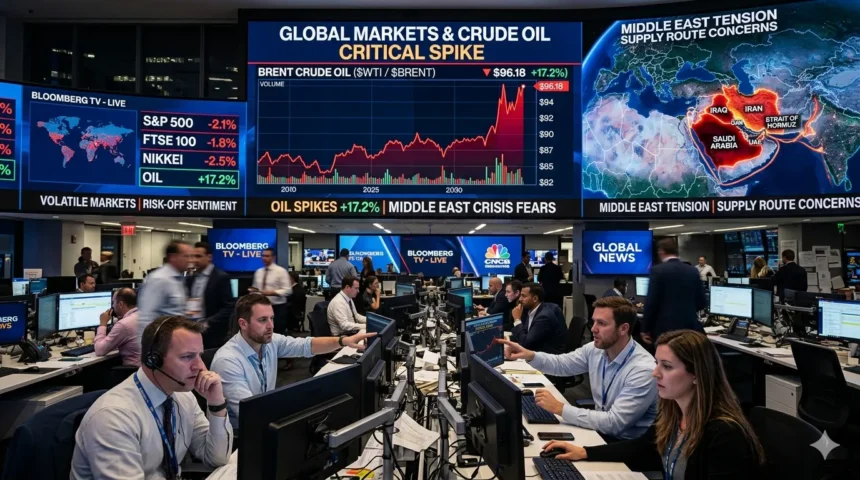
Markets Can’t Relax Even if Iran War Ends – Here’s What Investors Are Missing
It seems that even if the Iran War were to come to a sudden stop, the current state of the global financial markets will not be affected in a significant way. This was revealed by some of the insights given by David Solomon. In essence, Solomon was warning investors that even if the war were to come to a quick end, the markets will need some time to totally understand the economic implications.
The main point that investors need to understand is that even if the war were to come to a quick end, its implications will not be felt that way.

Markets React First, Understand Later
It was also mentioned that the current reaction to the war in Iran has been quite “benign” for the markets. However, it will be a while before investors can totally understand the implications. It should be noted that in the past, the markets have not always reacted to economic changes right away. This is precisely the point that is making this period a bit tricky.
Oil Shock: The Real Driver
Even as geopolitical risks recede, the biggest overhang for the markets remains the energy space, which comprises:
- Disruptions in the strategic shipping lanes like the Strait of Hormuz.
- High crude prices, which are a concern for global inflation.
- Uncertainty in crude prices, even as a ceasefire is indicated.
The recent stock market movements indicate how sensitive the markets are to movements in crude prices. Even as positive news emerges about a possible war ceasefire, the stock markets are volatile, indicating a lack of conviction in the markets.
Inflation & Interest Rate Pressure
A rise in crude prices, therefore, has a spillover impact on the entire economy, which comprises:
- Rise in crude prices → Rise in inflation.
- Rise in inflation → Delayed rate cuts.
- Delayed rate cuts → Rise in bond yields, which impacts equity valuations
Smart Money Isn’t Relaxing
Although positive sentiments are being expressed about the possibility of ceasefire talks, experts are advising caution as follows:
- The markets have responded favorably to the news of a possible ceasefire.
- The markets, however, are still very volatile.
- Institutional investors are predicting sideways or volatile markets.
Experts have indicated that the biggest problem for the markets is the uncertainty, as opposed to the war.
What Traders Should Watch
- The movement of the price of oil after the ceasefire.
- Central banks’ signals on the level of inflation.
- The level of bond yield volatility.
- The global risk sentiment, i.e., the level of the VIX.
- The earnings season to confirm the impact of the war on the economy.
The Bigger Picture: Calm Headlines, Unsettled Markets
Markets tend to price the event but miss the aftereffects.
Even if the Iran War ends tomorrow:
- The supply chain may still be disrupted.
- Energy prices may not return to normal right away.
- Investor positioning may take time to adjust.
That’s why this phase is so important.
The danger for traders isn’t the war; the danger is thinking the risk goes away when the headlines do.
Disclaimer:
The article is for general information purposes only and should not be taken as investment advice. It is to be noted that investments in the stock market are always associated with risk. It is advised to consult certified investment advisors before making any investment decisions.
Reviewed for accuracy and last updated on March 26, 2026.