



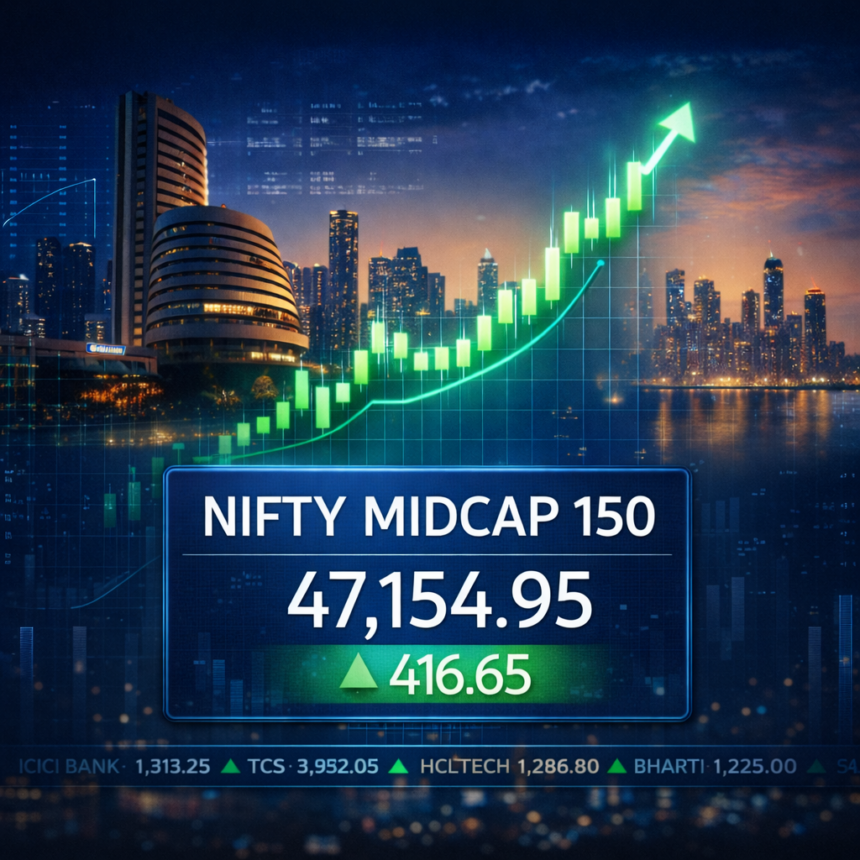
Nifty Midcap 150: A Guide to India’s Growth Index
The nifty midcap 150 has become a key index for investors who want exposure to India’s fast-growing companies – firms that are bigger than small caps but still have more room to grow compared to large, established giants.
In this guide, we explain what the nifty midcap 150 is, how it works, what kind of stocks it includes, its performance, risks, and how you can invest in it as part of your portfolio.

What Is Nifty Midcap 150?
The nifty midcap 150 is an index maintained by NSE Indices that tracks the performance of 150 mid-cap companies listed on the National Stock Exchange (NSE).
These companies sit between large caps and small caps in terms of market capitalisation. They are often well-known within their industries, have growing revenues, and are expanding their market presence.
In simple terms, nifty midcap 150 shows how India’s mid-sized companies are performing.
Why Midcap Stocks Matter

Midcap stocks are seen as the “sweet spot” for many investors because they offer:
- Better growth potential than large caps
- More stability than small caps
- Businesses in expansion phase
- A balance of risk and reward
That’s why the nifty midcap 150 attracts investors looking for long-term wealth creation with manageable risk.
How Is the Nifty Midcap 150 Built?
The index is formed from the Nifty Midcap 250 universe. From this pool, 150 companies are selected based on:
- Free-float market capitalisation
- Liquidity and trading volumes
- Compliance with NSE rules
- Sector representation
Like most Indian indices, nifty midcap 150 uses the free-float market cap method, ensuring only publicly traded shares influence the index.
This makes it easy for index funds and ETFs to replicate.
What Kind of Companies Are in Nifty Midcap 150?
The stocks in the nifty midcap 150 come from a wide range of sectors, including:
- Financial services & NBFCs
- Pharmaceuticals & healthcare
- Infrastructure & construction
- Chemicals & speciality materials
- IT services
- Consumer goods
- Capital goods & engineering
- Auto ancillaries
These are companies that are often leaders in niche markets and have the potential to become large caps in the future.
Note: Constituents change over time as NSE reviews the index. Always refer to the NSE Indices website for the latest list.
How Often Is Nifty Midcap 150 Reviewed?
The nifty midcap 150 is typically reviewed twice a year by NSE Indices.
During these reviews:
- New fast-growing companies may be added
- Slower or less liquid stocks may be removed
- Weightages are adjusted
This keeps the index aligned with current market leaders in the midcap space.
Performance of Nifty Midcap 150 Over Time
Historically, midcap indices in India have:
- Outperformed large caps during strong bull markets
- Fallen more during market corrections
- Shown higher volatility than Nifty 50
The nifty midcap 150 has delivered strong long-term returns for patient investors, but with noticeable ups and downs along the way.
This makes it suitable for investors with a longer time horizon who can ride out volatility.
Nifty Midcap 150 vs Nifty 50
Here’s how the nifty midcap 150 compares with the large-cap Nifty 50:
| Feature | Nifty Midcap 150 | Nifty 50 |
|---|---|---|
| Tracks | 150 midcap stocks | 50 large-cap stocks |
| Growth potential | High | Moderate |
| Risk | Medium to high | Lower |
| Volatility | Higher | Lower |
| Stability | Moderate | High |
While Nifty 50 offers stability, nifty midcap 150 provides growth.
Why Investors Choose Nifty Midcap 150
Investors are drawn to the nifty midcap 150 because:
- Midcaps can become tomorrow’s large caps
- Offers diversification beyond blue chips
- Strong compounding over long term
- Balances growth with relative stability
Many long-term portfolios include midcap exposure for this reason.
Risks of Investing in Nifty Midcap 150
Midcaps are not risk-free. Key risks include:
- Sharper corrections in bad markets
- Lower liquidity than large caps
- Company-specific risks
- Higher volatility
- Emotional reactions during swings
Investors should be prepared for short-term pain in exchange for long-term gain.
Who Should Invest in Nifty Midcap 150?
The nifty midcap 150 is suitable for investors who:
- Have a 5-10 year horizon
- Can tolerate moderate volatility
- Want better growth than large caps
- Already hold large-cap funds
- Prefer SIP investing for discipline
If capital safety is your top priority, large caps may suit you better.
How Can You Invest in Nifty Midcap 150?
You can’t invest directly in the index, but you can gain exposure through:
- Index mutual funds tracking nifty midcap 150
- ETFs based on the index
- Some PMS or model portfolios
Index funds and ETFs are the most accessible for retail investors.
SIP vs Lump Sum in Nifty Midcap 150
Because of volatility, many experts suggest using SIP (Systematic Investment Plan) for midcap indices.
SIP Benefits:
- Smoothens market ups and downs
- Reduces timing risk
- Builds investing discipline
Lump sum may work during market corrections, but SIP is safer for most.
Taxation on Nifty Midcap 150 Funds

Tax calculation for Nifty Midcap 150 investments
Equity funds tracking nifty midcap 150 follow standard equity taxation:
- Less than 1 year: 15% short-term capital gains tax
- More than 1 year: 10% LTCG above ₹1 lakh
Tax rules can change, so check latest guidelines or consult an expert.
How Nifty Midcap 150 Fits into Your Portfolio
A balanced portfolio may include:
- Large caps for stability
- Midcaps for growth
- Small caps for high-risk returns
For midcaps, many advisors suggest limiting exposure to a sensible portion based on your risk profile.
To add higher growth exposure, you may also look at Small Cap Nifty 50 for emerging companies.
Common Myths About Midcaps
(X) Midcaps are too risky
(_/) They are riskier than large caps, but more stable than small caps.
(X) Midcaps always outperform
(_/) They outperform in bull phases, not always.
(X) Midcaps are for experts only
(_/) Beginners can invest through SIPs.
Things to Check Before Investing
Before investing in nifty midcap 150 funds, check:
- Expense ratio
- Tracking error
- Fund house credibility
- Your time horizon
- Asset allocation
Don’t invest just because returns look good.
Final Thoughts on Nifty Midcap 150
The nifty midcap 150 offers a smart way to tap into India’s growth story beyond large, established companies. It gives exposure to mid-sized firms that are expanding, innovating, and steadily building their market presence.
While the journey can be bumpy, investors who stay patient, invest regularly, and keep a long-term view can benefit from the wealth-creation potential of the nifty midcap 150.
For those who already hold large caps and want the next layer of growth, this index deserves a place on the watchlist.
Reviewed for accuracy and last updated on December 26, 2025.