


Global Markets Shift From Q1 Rout to Q2 Risks -What Investors Are Watching Now
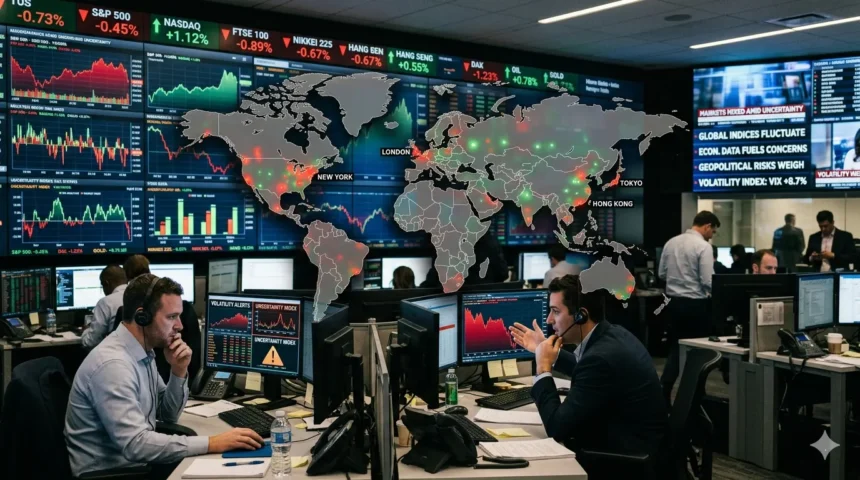
Global markets are moving into Q2 with an uncertain tone following a volatile start to the year. Markets are reacting sharply to various risks, which are expected to guide them in the coming days.
After witnessing an extremely volatile Q1 with sharp market swings and sectoral corrections, markets are now moving into Q2. What are the risks that can guide markets in the coming days?

Immediate Market Reaction
- Global markets witnessed an extremely volatile Q1 with heightened volatility in global equities.
- Risk appetite is selective in nature across global markets.
- Benchmark indices such as S&P 500 and MSCI World Index are witnessing an uneven trend.
The markets are no longer moving in a straight line but are reacting sharply to various risks.
What’s Driving the Uncertainty?
Various factors are contributing to the uncertainty. Some of these include:
- The inflation rate is still uneven in all economies.
- Central banks are still balancing economic growth with rate policy.
- Geopolitical tensions are impacting energy prices.Geopolitical tensions are impacting energy prices.
- Earnings visibility is still mixed among corporations.
This is creating an environment that is not clear but risky.
Supply–Demand Angle
The transition from Q1 to Q2 is driven by changes in investor positioning. Some of these changes include:
- Aggressive risk-taking is reduced.
- Investors have started buying defensive stocks.
- Select buying rather than broad-based markets.
While liquidity is still present in the markets, it is becoming more cautious.
Analyst View
Markets could be more nuanced in Q2, according to market strategists.
“Markets are transitioning from a liquidity-driven phase to a data-driven phase, where macro data will have more influence,” said a global strategist.
This is usually driven by short-term volatility.
Key Risks in Q2
Investors are closely watching:
- Central bank policy decisions.
- Inflation rate in major economies.
- Movement in bond yields.
- Exchange rate movements.
- Geopolitical events.
All of these factors have the potential to shift market sentiment in the near term.
Broader Context
The previous rallies in the markets have been accompanied by:
- Liquidity infusions.
- Strong earnings cycles.
- Economic recovery optimism.
However, now markets are moving into a phase where valuations and macroeconomic factors are being watched more closely.
What Traders Need to Watch
- Key resistance and support points in global markets.
- Sector rotation trends.
- Institutional fund flows.
- Economic data points (inflation, GDP, etc.).
- Volatility indicators.
Bigger Signal for Markets?
The move from Q1 to Q2 is less about direction, and more about uncertainty.
The key question is:
Will markets stabilize with clearer macro signals, or remain volatile with increasing risks?
For traders, this period can be a litmus test for trend followers vs. risk managers.
For in uncertain markets, the biggest signal can often be the return of clarity, rather than the peak of uncertainty.
Disclaimer:
The reader is hereby advised that this article is for informational purposes only. It is not investment advice. There are risks and volatility in global markets. Therefore, it is recommended to consult certified financial advisors before making any investment.
Reviewed for accuracy and last updated on March 30, 2026.