


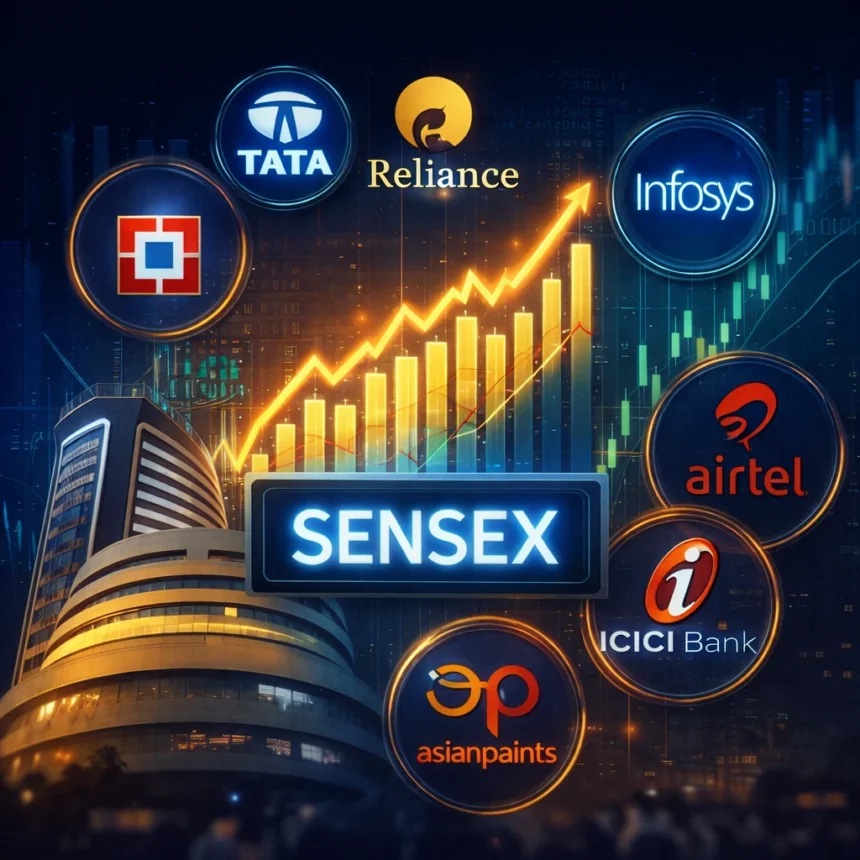
What Are the 30 Shares in Sensex? Full List Explained
If you track the Indian stock market, you’ve surely heard that the Sensex represents India’s top companies. But exactly what are the 30 shares in Sensex, and why do these companies matter so much?
The Sensex, or Sensitive Index, is made up of 30 large, well-established companies listed on the Bombay Stock Exchange (BSE). Together, they reflect the health of India’s economy and stock market. In this article, we take a close look at the current Sensex stock list, the sectors they come from, and what makes them so important for investors.

Note: The Sensex constituents are reviewed periodically by BSE. The list below reflects the commonly known current set as of recent years. Always check the BSE website for the latest updates.
What Is Sensex and Why Only 30 Stocks?
Before jumping into the list, it’s important to understand why Sensex has just 30 companies.
The idea is simple: pick a small group of blue-chip companies that:
- Are financially strong
- Have large market value
- Are actively traded
- Represent key sectors of the economy
These 30 stocks act as a snapshot of India’s corporate world. When they perform well, Sensex rises. When they struggle, Sensex falls.
The Current List: 30 Shares in Sensex
Here is the list of the 30 shares in Sensex that form India’s benchmark index:
- Reliance Industries Ltd
- Tata Consultancy Services (TCS)
- HDFC Bank
- ICICI Bank
- Infosys
- State Bank of India (SBI)
- ITC
- Hindustan Unilever (HUL)
- Larsen & Toubro (L&T)
- Axis Bank
- Kotak Mahindra Bank
- Bajaj Finance
- Bajaj Finserv
- Maruti Suzuki India
- Mahindra & Mahindra
- Tata Motors
- Sun Pharmaceutical Industries
- Dr Reddy’s Laboratories
- NTPC
- Power Grid Corporation
- UltraTech Cement
- Tata Steel
- JSW Steel
- IndusInd Bank
- Nestle India
- Asian Paints
- Titan Company
- Bharti Airtel
- HCL Technologies
- Tech Mahindra
These companies come from diverse sectors like banking, IT, energy, FMCG, automobiles, pharma, metals, telecom, and infrastructure.
Which Sectors Do the Sensex Stocks Represent?
The 30 Sensex stocks are spread across key sectors:
- Banking & Finance: HDFC Bank, ICICI Bank, SBI, Axis Bank, Kotak, Bajaj Finance, Bajaj Finserv
- IT: TCS, Infosys, HCL Tech, Tech Mahindra
- Energy: Reliance Industries
- FMCG: ITC, HUL, Nestle India
- Auto: Maruti Suzuki, Tata Motors, M&M
- Infrastructure: L&T
- Pharma: Sun Pharma, Dr Reddy’s
- Power: NTPC, Power Grid
- Cement: UltraTech
- Metals: Tata Steel, JSW Steel
- Consumer Durables: Asian Paints, Titan
- Telecom: Bharti Airtel
This mix ensures Sensex reflects the broader economy.
How Are the 30 Shares in Sensex Selected?
The BSE follows a transparent process to select Sensex stocks. Companies must:
- Be listed on BSE
- Have high free-float market capitalisation
- Show good liquidity and trading volume
- Be leaders in their sector
- Meet governance and compliance standards
The index committee reviews the list from time to time. Stocks can be added or removed to keep Sensex relevant.
Do the Same 30 Stocks Always Stay in Sensex?
No. The list changes over time.
As new companies grow and old ones lose relevance, BSE updates the index. For example:
- Tech and private banks have gained more weight in recent years.
- Older manufacturing firms have seen reduced presence.
This dynamic nature helps Sensex stay aligned with India’s changing economy.
Why These 30 Shares Matter to Investors
The 30 shares in Sensex are important because:
- They drive daily Sensex movements
- Many mutual funds track them
- Foreign investors watch them closely
- They act as market leaders for their sectors
If these stocks perform well, overall market sentiment improves.
Can You Invest in the 30 Shares in Sensex?
You can’t buy Sensex directly, but you can invest in:
- Individual Sensex stocks
- Index mutual funds
- ETFs based on Sensex
- Futures & options on Sensex
For beginners, index funds are a simple way to get exposure to all 30 stocks at once.
How Much Weight Does Each Stock Have?
Each stock’s impact on Sensex depends on its free-float market capitalisation. Bigger companies like Reliance, TCS, and HDFC Bank carry more weight, so their price movement affects Sensex more than smaller constituents.
That’s why a sharp move in one heavyweight stock can move the index significantly.
How Often Does BSE Review the Sensex List?
The BSE typically reviews Sensex constituents twice a year or when needed. The goal is to ensure:
- The index remains liquid
- It reflects current market leaders
- Sector balance is maintained
Any change is announced in advance.
Sensex Stocks vs Nifty Stocks
Many investors compare Sensex with Nifty 50.
| Sensex | Nifty 50 |
|---|---|
| 30 stocks | 50 stocks |
| Based on BSE | Based on NSE |
| Older index (1986) | Launched in 1996 |
| Tracks top blue chips | Broader market view |
Both are important, but Sensex is often seen as the face of Indian markets.
👉 Read more: Difference between Sensex and Nifty.
How to Track the 30 Shares in Sensex
You can track Sensex stocks through:
- BSE website
- Stock market apps
- Brokerage platforms
- Business news channels
Most apps show real-time prices, weights, and charts of each stock.
Are Sensex Stocks Safe to Invest In?
While Sensex stocks are large and stable companies, no stock is risk-free.
They are generally:
- More resilient during downturns
- Better governed
- Less volatile than small caps
Still, prices can fall during market crashes. Long-term investing with diversification is key.
Lessons for Investors from Sensex Stocks
From the performance of Sensex stocks over decades, investors learn:
- Strong companies survive cycles
- Long-term holding builds wealth
- Market leaders keep changing
- Patience is rewarded
Many of today’s top stocks weren’t leaders 20–30 years ago.
Reviewed for accuracy and last updated on December 24, 2025.