


India’s FTAs Boost Exports — But Why Are Deficits Still Rising?
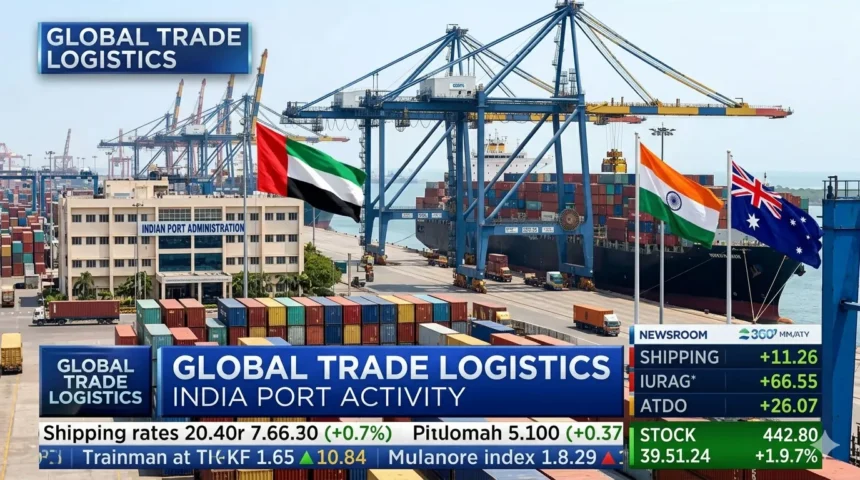
India’s free trade agreements with the UAE and Australia are starting to gain traction in exports, but the increasing imports from these countries are still a matter of concern for India, which is affecting the trade deficit.
This is a paradoxical situation for India, as the country is benefiting from free trade agreements in the context of exports with the UAE and Australia, but the trade deficit with these countries is increasing.

Immediate Market Reaction
Macro-sensitive sectors that could attract more attention:
- Export-oriented companies may gain as volume growth is expected.
- Import-dependent industries may be impacted as margins may be hit.
- Currency-dependent companies may react if the deficit impacts the rupee.
Markets watch these trends to get early signals in sectors like IT, Pharma, and metals.
Supply-Demand Perspective: Imports Outpacing Exports
FTAs are meant to improve trade volumes; however, the balance is achieved on the basis of competitiveness.
- Less tariffs → imports become cheaper and grow faster.
- Exports grow → slower as companies take time to scale up.
- Net Result: Trade deficit increases in the short term
In the Indian context, robust demand for commodities, energy products, and high-value products from partner countries is compensating for export growth.
Analyst Insight
According to economists, it is not unusual to see this phenomenon during the initial phases of FTA.
“Trade agreements tend to result in a surge in imports before exports take off in a major way,” said a policy analyst who monitors India’s external trade.
The major focus of the market is on whether exports sustain in the long term.
Broader Context: Strategic Expansion of Trade
India has been actively pursuing FTAs to:
- Diversify export destinations.
- Break dependence on traditional trade partners.
- Strengthen supply chain engagement globally.
The agreements with UAE and Australia are part of a larger strategic move to establish India as a major trade hub.
The deficits, however, also raise questions on:
- The competitiveness of Indian manufacturers.
- The import dependence in certain sectors.
- Currency stability.
Bigger Market Signal
And for the markets, it’s not just a trade story. It’s a macro signal.
So, if the export momentum continues to build, there could be a re-rating for sectors that are tied to global demand. But if these deficits continue to expand, there could be concerns about currency and external stability.
And that’s why, even though it’s not immediately obvious, this could be an important market driver in the months to come.
Disclaimer:
This article is for informational purposes only and does not constitute investment advice. Market investments are subject to risks. Readers should consult certified financial advisors before making financial decisions.
Disclaimer:
This article is for informational purposes only and does not constitute investment advice. Market investments involve risk. Readers are advised to consult certified financial advisors for investment decisions.
Reviewed for accuracy and last updated on March 24, 2026.