


Excise Cuts to Hit Govt Revenue – Will Fiscal Pressure Build Next?
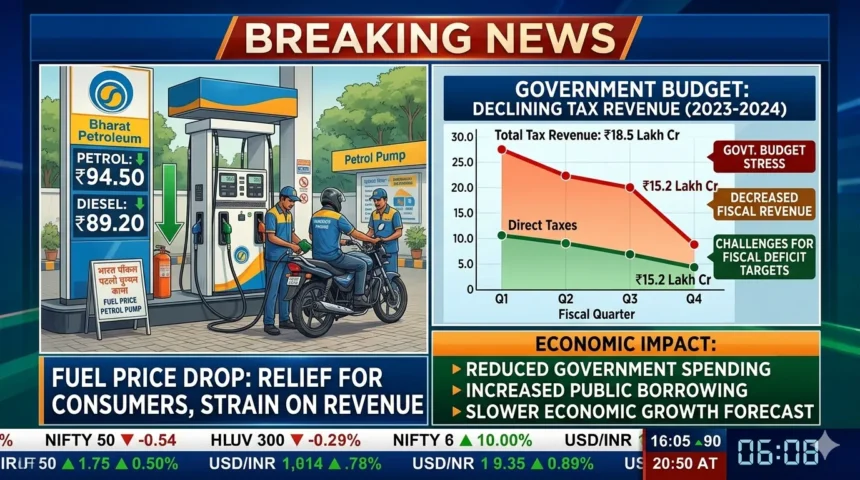
The recent reduction in excise duty on petrol and diesel is set to cause a hit to the exchequer to the tune of ₹1.2 lakh crore in FY27. The reduction is likely to add to the existing pressure on the government’s finances.
Though the reduction is aimed at curbing inflationary pressure, it is now being analyzed for its long-term effects on the government’s finances.

Immediate Market Reaction
Macro fiscal events generally take time to influence markets. They do not have an immediate impact:
- Bond markets might react to an increase in borrowing needs.
- Sectors such as banking might attract greater attention.
- Indices such as Nifty 50 might not be immediately impacted, but macro events might build over time.
The actual impact is more likely to be seen through fiscal deficit expectations rather than immediate equity markets.
Why the Revenue Loss Matters
The fuel tax is a vital source of revenue for the government. Such a loss in revenue would mean:
- Less tax collected by the government.
- Fiscal deficit may rise further.
- Government may have to borrow more money.
The amount of loss in revenue, at ₹1.2 lakh crore, is a significant amount that would be taken into consideration in the calculations for the upcoming FY27.
Supply–Demand Angle
There is a balancing effect in the excise cut:
- Lower fuel prices → consumption and demand will increase.
- Lower revenue → government spending flexibility would be impacted.
This is a classic macro trade-off.
Analyst Perspective
The decision has been seen as a positive for inflation by economists.
“Excise cuts help control inflation in the near term, but the fiscal cost needs to be managed through other revenue channels or expenditure control,” said a macro analyst.
The market is also looking at how this revenue gap is being filled.
Broader Context
India has used fuel tax as a policy tool to manage inflation when crude prices are high and also to increase revenue when crude prices are low.
- To control inflation in high crude price cycles.
- To increase revenue in a scenario of low oil prices globally.
With volatile crude prices, such interventions are becoming more regular.
What Traders Should Watch
- Fiscal deficit projections for FY27.
- Government borrowing schedule.
- Bond yields.
- Inflation trends post fuel price cuts.
- Revenue offset measures.
Bigger Signal for Markets?
At first glance, a tax cut on fuel is good news for consumers. But markets are always one step ahead.
If this revenue gap continues to rise, it could lead to:
- Increased Borrowing.
- Higher Bond Yields.
- Liquidity.
The ₹1.2 lakh crore question, for now, is not about revenue loss, but about how this revenue gap is filled.
Because in macro markets, fiscal math is a trend that precedes news.
Disclaimer:
This article is for information only and not to be considered as investment advice. Investments in the market carry risks. Readers are advised to consult certified financial planners before making any financial decisions.
Reviewed for accuracy and last updated on March 27, 2026.