



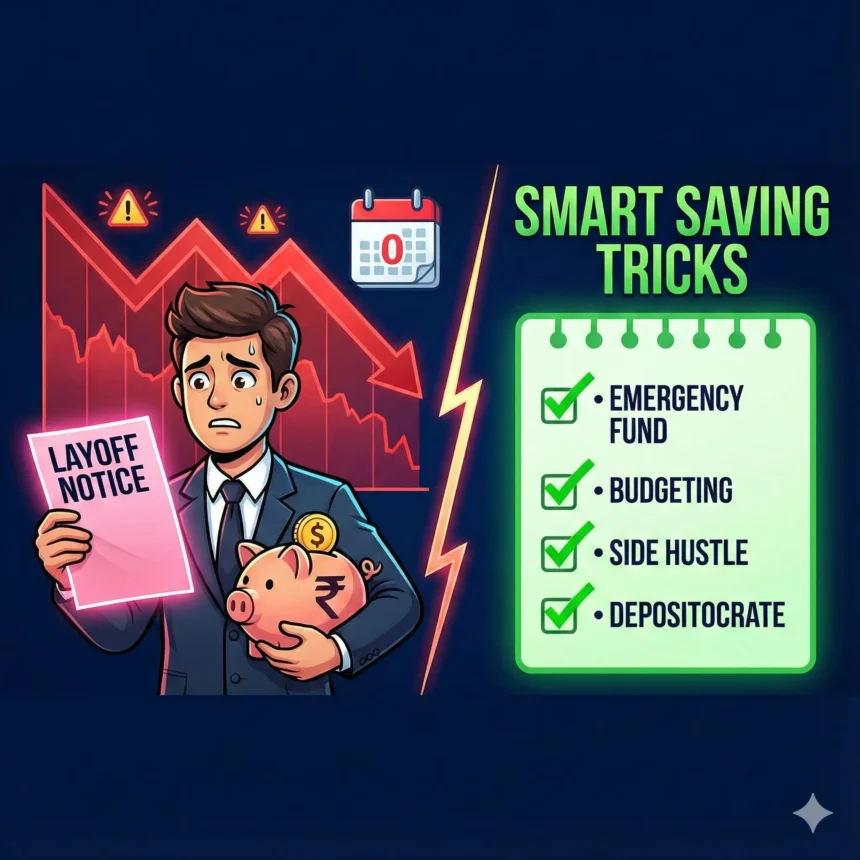
How to Save Yourself from Layoffs Using Smart Saving: Financial Survival Guide for Indian Professionals
Over the past few years, layoffs have become a harsh reality in India and around the world. Global companies – from IT giants to startups – have announced massive job cuts due to automation, cost reduction, inflation, funding winters, and economic uncertainty.

Industries like IT, telecom, fintech, e-commerce, banking, media, real estate, and manufacturing have all seen job losses. Recruitments have slowed, appraisals have shrunk, and job security feels uncertain for many professionals.

In an environment where layoffs can appear without warning, one lesson has become clear:
Your strongest job security is not your company – it is your financial planning.
Whether you are a fresher, mid-level employee, or senior manager, financial stability depends on how well you save, invest, prepare, and protect yourself before a crisis hits.
This article explains how smart saving strategies can help you survive layoffs confidently, without stress or panic.
Why Layoffs Happen – Even to Good Employees
Layoffs are rarely personal. Companies take this decision to:
- Reduce costs during financial slowdown
- Improve efficiency through automation or AI
- Respond to falling revenue or shrinking demand
- Cut expenses when funding reduces
- Consolidate multiple teams after mergers
- Shift operations to cheaper regions
Even high-performing employees can lose jobs due to business restructuring, not personal failure.
The real question is:
Are you financially prepared if you lose your job tomorrow?
Rule #1 – Build an Emergency Fund
The emergency fund is your financial life jacket during layoffs.
How much should you save?
Experts suggest saving 6 – 12 months of monthly expenses.
If your monthly expenses = ₹30,000
Emergency fund goal = ₹1.8 lakh – ₹3.6 lakh
This money must be kept in:
- High-interest savings account
- Liquid mutual funds
- FD with instant withdrawal option
Why this matters
✔ Gives time to find a new job
✔ Avoids borrowing or credit card debt
✔ Reduces mental stress
✔ Keeps family financially protected
Rule #2 – Avoid Living Paycheck to Paycheck
Many employees spend everything they earn every month.
Create a simple format:
50-30-20 Rule
| Category | Percentage |
|---|---|
| Necessities (rent, food, utilities) | 50% |
| Lifestyle / personal expenses | 30% |
| Savings & Investments | 20% |
If you cannot save 20%, start with 5–10% and increase slowly.
Rule #3 – Reduce Liabilities and High-Interest Debt
Layoffs become disastrous when:
- Home loan EMIs
- Credit card bills at 36% per year
- Personal loans
- Buy-now-pay-later (BNPL)
Create a priority plan:
- Close credit card debt first
- Reduce EMI burden using part-payment or refinancing
- Avoid unnecessary loans for luxury purchases
Avoid paying interest for lifestyle.
Rule #4 – Build Multiple Income Streams
Never depend on one salary.
Possible additional income sources:
- Freelancing & consulting
- Skill teaching / digital courses
- YouTube, blogging, content creation
- Rental income (room / garage)
- Part-time remote projects
- Comedy, music, photography, arts
- Selling handmade products or craft work
Even earning ₹5,000 – ₹15,000 per month extra can become survival money if layoff hits.
Rule #5 – Cut Lifestyle Inflation
When salary increases, expenses automatically rise — upgraded smartphone, new bike, weekend dinners, impulse shopping.
Lifestyle inflation kills savings.
Try:
- No-spend weekends
- Use public transport or shared rides
- Cancel unused subscriptions
- Repair instead of replace
- Reduce luxury EMIs
Real wealth comes from consistency, not consumption.
Rule #6 – Invest Smartly for Future Stability
Saving money is not enough — money must grow.
Safe investment options for working professionals:
- SIP in mutual funds
- Public Provident Fund (PPF)
- EPF contribution increase
- NPS for retirement
- Gold ETFs
- High-interest FD / RD
Avoid risky trading without knowledge.
Rule #7 – Mental Preparedness & Planning Ahead
Being emotionally prepared reduces panic during job uncertainty.
- Update resume every 3 months
- Keep networking active
- Learn new skills constantly
- Maintain a positive money mindset
You cannot control layoffs. You CAN control readiness.
Signs Your Company May Plan Layoffs
Stay alert if you notice:
- Frequent cost-cutting initiatives
- Hiring freeze announcements
- Reduced project pipeline
- Senior executives resigning
- Delayed appraisals & promotions
- Sudden performance pressure
- Quiet restructuring
If these appear — increase savings immediately.
Layoffs Reality in Indian Job Market
India is experiencing:
- Startup funding slowdown
- AI replacing repetitive jobs
- Automation rise in IT support roles
- BPO & KPO cost restructuring
- Corporate budgets tightening
Smart savings today = power to survive tomorrow.
Final Takeaway
Financial freedom begins with self-reliance, not salary dependency. Saving money is like building armour-you hope you never need it, but you’re protected if anything happens. Layoffs are temporary.
Strong savings decisions last forever.
Quick Survival Checklist
| Step | Status |
|---|---|
| Emergency fund for 6 months | ⬜ |
| No high-interest loans | ⬜ |
| Spending control | ⬜ |
| Extra income source | ⬜ |
| Resume & skills updated | ⬜ |
| Peace of mind | ⬜ |
Start checking the boxes – one by one.
Want a personalized portfolio based on your age and income?
Fill this form and I’ll draft a sample plan.
Reviewed for accuracy and last updated on December 8, 2025.