


Beginners Guide: How to Evaluate Trading Courses Before Paying for Them
The stock market has become one of the fastest-growing interests among young Indians, with more than 15 crore demat accounts active in 2025. With increasing participation, thousands of new trading courses, academies, coaching programs, Telegram communities, and market trainers have entered the education space promising quick profits and financial freedom.
However, not all trading courses are genuine, and many beginners end up wasting money, time, and sometimes even losing capital by following unverified strategies or tips disguised as education. Recent SEBI actions against unregistered advisory services have highlighted the importance of due diligence before selecting any trading course.

If you are a beginner planning to learn trading, this detailed guide will help you understand how to evaluate a stock market course properly and avoid costly mistakes.
Why Choosing the Right Trading Course Matters
Learning the stock market is different from learning any other skill because:
- It involves real money and high risk
- Wrong guidance can lead to financial loss
- Shortcuts or tips-based learning often causes dependency
- Market success requires discipline and long-term mindset
A good course can teach:
- Risk management
- Trading psychology
- Strategy development
- Technical and fundamental analysis
- How to build your own trading system
A bad course can:
- Sell unrealistic profit dreams
- Encourage gambling-style trading
- Push unverified signals
- Misrepresent earnings records
So choosing the right course is a critical investment decision, not just an educational choice.
Checklist: How to Evaluate Trading Courses (Beginner Friendly)
1️⃣ Verify SEBI Compliance
One of the first things to check is whether the trainer or academy is SEBI-registered if they provide:
- Stock tips
- Buy/Sell targets
- Stop-loss and position sizing guidance
- Portfolio advisory
If a course claims “Guaranteed profits,” “Multibagger picks,” “Daily live calls,” or “Follow our trades,” then legally the trainer must be registered as:
- Investment Advisor (IA) or
- Research Analyst (RA)
👉 Search the official list here:
https://www.sebi.gov.in/
Red flag:
❌ Telegram calls, WhatsApp signals, paid advisory without registration.
Check Trainer Background & Real Experience
Look beyond social media reels and flashy screenshots.
Ask:
- How many years of actual market trading experience?
- Do they trade live with transparency?
- Do they provide proof such as audit statements?
A good trader-teacher will talk about:
✔ Losses and risk
❌ Not just profits
Avoid courses where the trainer behaves like a motivational speaker instead of a market practitioner.
Understand the Syllabus & Learning Structure
A professional trading course must teach concepts like:
- Candlestick & chart patterns
- Demand-supply zones
- Risk-reward ratio
- Breakout & breakdown structure
- Position sizing
- Trading psychology
- Backtesting and journaling
Beware of robotic ‘One secret strategy’ pitches.
Real trading needs process, not magic formulas.

Avoid Programs That Promise Unrealistic Returns
Statements like:
- “Earn ₹10,000 daily from options trading”
- “Turn ₹10,000 into ₹5 lakh in 3 months”
- “100% accuracy strategy”
These are clear fraud indicators.
Stock markets do not guarantee fixed returns, and even the best traders expect accuracy around 50–60% with risk control.
Validate Student Feedback (Authentic, Not Paid)
Look for real reviews:
- Independent platforms like Google, LinkedIn, Trustpilot, Quora
- YouTube reviews where people show results with reasoning
- Case studies showing progress, not screenshots of profits
Fake review pattern warning:
* Repetitive single-sentence reviews.
* Forced praise on social media groups.
* Paid influencers endorsing courses.
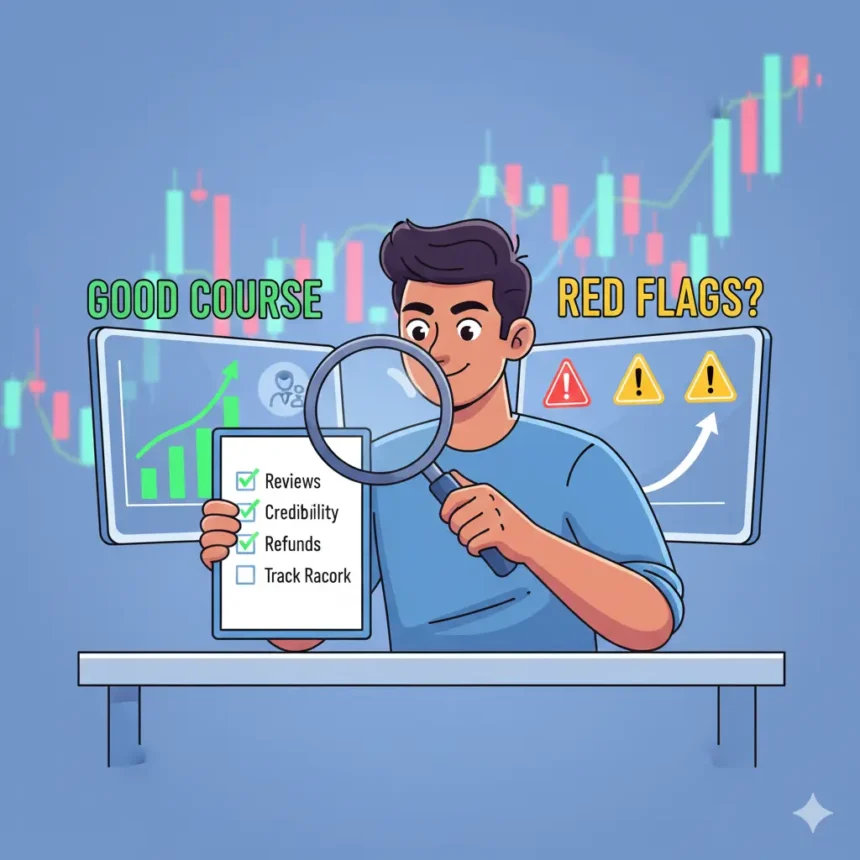
Check Refund & Fee Transparency
Legitimate training institutes provide:
✔ Clear fee structure
✔ Refund or cancellation policy
✔ No hidden charges
Scam-like models pressure people:
* “Prices increase in 2 minutes, decide now”
* “Last batch, limited seats, EMIs only today”
High-pressure sales ≠ good education.
Trial Classes & Course Preview
Always take a demo session to evaluate:
- Teaching quality
- Concept clarity
- Practical strategy explanation
- Culture of community
If a course hesitates to show demo, think twice.
Learn Whether They Teach ‘How to Think’ or ‘What to Trade’
Education means learning the process, not copying trades.
| Real learning | Red flag |
|---|---|
| Teaches frameworks & independence | Shows exact stock tips |
| Encourages self-analysis | Encourages blind copying |
| Focus on psychology | Focus on excitement |
Your goal should be to become a professional trader, not a follower.
Questions Every Beginner Should Ask Before Joining
- What is the expected learning outcome?
- What timeframe to break even in skill development?
- Is live practice included?
- Do they teach journaling and backtesting?
- What support is provided after completion?
- Are communities moderated & productive?
If answers are vague or motivational — reconsider.
Why Many Beginners Lose Money Despite Joining Courses
- They chase hype
- They avoid risk management training
- They rely on calls instead of building skills
- They trade large capital early with no discipline
- They fall into emotional traps
Successful traders spend months practicing on a simulator or paper trading first.
Why This Matters for Indian Retail Traders
With rapid growth in F&O trading participation and many young investors entering the market:
- Scams and misleading advisory businesses have increased
- SEBI is tightening norms to protect retail traders
- More than 90% retail traders in F&O lose money (SEBI report)
Learning responsibly is essential.
Conclusion: Choose Wisdom, Not Hype
Choosing a trading course is your first investment decision.
Don’t rush based on social media influencers, screenshots, or loud marketing claims.
A good trading course will:
✔ Teach risk control and discipline
✔ Build independent decision-making skills
✔ Teach process, analysis and execution
✔ Emphasize journaling & psychology
A bad course will:
* Sell quick-profit dreams
* Encourage blind following
* Hide losses and risk
In trading, education is the best investment — but only if chosen wisely.
Reviewed for accuracy and last updated on December 5, 2025.