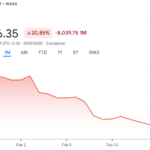




DMart Q3 Results (Avenue Supermarts,) the company that runs the DMart supermarket chain, has once again shown why it is considered one of the steadiest names in Indian retail. At a time when many consumer-facing businesses are dealing with uneven demand and shifting price trends, DMart has managed to grow both sales and profits without losing its grip on costs.
For the quarter ended December 31, 2025, the company reported a 17.6% year-on-year rise in standalone net profit, taking the figure to ₹923 crore. The improvement came alongside stable revenue growth and better operating margins, something that is not easy to achieve in a competitive retail market.

In simple terms, DMart is still doing what it does best: selling everyday products at low prices, keeping expenses tight, and turning that discipline into profit.
Revenue for the quarter grew 13.2% to ₹17,613 crore, up from ₹15,565 crore in the same period last year. What made this quarter stand out was how efficiently the company converted that growth into earnings. EBITDA rose nearly 20% to ₹1,481 crore, and the margin improved to 8.4% from 7.9% a year ago. Profit margins edged higher to 5.2%, and earnings per share climbed to ₹14.19 from ₹12.06.
This Year: Last Quarter vs This Quarter
(Q2 FY26 = Sep 2025 | Q3 FY26 = Dec 2025 – Consolidated)
| Metric | Q2 FY26 (Sep 2025) | Q3 FY26 (Dec 2025) | Change |
|---|---|---|---|
| Sales (₹ Cr) | 16,676 | 18,101 | ▲ 8.5% |
| Purchases / Expenses (₹ Cr) | 15,463 | 16,638 | ▲ 7.6% |
| EBITDA / Operating Profit (₹ Cr) | 1,214 | 1,463 | ▲ 20.5% |
| Net Profit (₹ Cr) | 685 | 856 | ▲ 25.0% |
| EPS (₹) | 10.53 | 13.15 | ▲ 24.9% |
This table shows how sharply profitability improved in just one quarter. While sales grew at a healthy pace, profit and EPS rose much faster, reflecting better cost control.
Year-on-Year: Last Year vs This Year
(Q3 FY25 = Dec 2024 | Q3 FY26 = Dec 2025 – Consolidated)
| Metric | Q3 FY25 | Q3 FY26 | YoY Change |
|---|---|---|---|
| Sales (₹ Cr) | 15,973 | 18,101 | ▲ 13.3% |
| Purchases / Expenses (₹ Cr) | 14,755 | 16,638 | ▲ 12.8% |
| EBITDA / Operating Profit (₹ Cr) | 1,217 | 1,463 | ▲ 20.2% |
| Net Profit (₹ Cr) | 724 | 856 | ▲ 18.3% |
| EPS (₹) | 11.12 | 13.15 | ▲ 18.3% |
This comparison highlights how DMart has not only grown sales over the year but has also widened the gap between income and costs, leading to stronger profit growth.
Shareholding Pattern (Latest Change)
Place this table after the section “What DMart Q3 results mean for investors”, as it directly relates to investor behaviour.
| Category | Jun 2025 | Sep 2025 | Change |
|---|---|---|---|
| Promoters | 74.65% | 74.65% | No change |
| FIIs | 8.25% | 8.73% | ▲ 0.48% |
| DIIs | 9.22% | 9.02% | ▼ 0.20% |
| Public | 7.79% | 7.53% | ▼ 0.26% |
You can introduce it with a simple line like:
The shareholding pattern also shows a subtle shift in investor interest:
These numbers may look technical on paper, but they tell a simple story. DMart is getting better at squeezing more profit out of every rupee it earns. That matters in a business where prices are often under pressure and customers are extremely value-conscious.
Explaining the performance, Anshul Asawa, CEO-designate of Avenue Supermarts, said revenue growth during the quarter was partly affected by deflation in staples, one of DMart’s most important categories. When prices of essential items fall, retailers can sell the same volumes but still see slower value growth. It’s a challenge that most grocery chains are facing right now.
Despite this, DMart’s profitability stayed strong. Asawa pointed out that stores which are two years old or more recorded growth of 5.6% during the quarter. That is an important detail. It suggests that once a DMart store settles into a neighbourhood, it continues to attract steady footfall and repeat customers. People keep coming back, not just for discounts, but because the store becomes part of their routine.
That loyalty is one of DMart’s biggest strengths. In a market crowded with options, customers still choose DMart for their regular shopping.
Expansion also continued during the quarter. The company added 10 new stores, taking the total count to 442 as of December 31, 2025. Unlike some retailers that expand aggressively and struggle to control costs, DMart has always been careful about where and how it grows. Each new store is expected to fit into the company’s low-cost model.
The brand’s “everyday low cost, everyday low price” approach remains central to its strategy. It is built around efficient sourcing, lean operations, and strict cost control. Over the years, this has allowed DMart to offer lower prices while still protecting margins. It is not flashy, but it works.
Looking beyond the quarter, the nine-month numbers show the same steady pattern. For the period ended December 31, 2025, standalone revenue rose 14.9% to ₹49,764 crore, while net profit grew 8.3% to ₹2,499 crore. EBITDA stood at ₹4,024 crore, with a margin of 8.1%.
Profit growth over nine months has been slower than revenue growth, but margins have remained healthy. In a sector where price wars are common, that balance is not easy to maintain.
The consolidated numbers mirror this trend. On a group basis, DMart reported Q3 revenue of ₹18,101 crore, up from ₹15,973 crore a year ago. Net profit increased to ₹856 crore from ₹724 crore, and the EBITDA margin improved to 8.1% from 7.6%. For the nine-month period, consolidated revenue stood at ₹51,137 crore compared with ₹44,486 crore last year, while net profit rose to ₹2,313 crore from ₹2,157 crore.
Taken together, these figures show a business that is moving forward without drama. There are no sudden spikes, no sharp falls-just steady execution.
For investors, the DMart Q3 results underline a few clear themes. Margins are improving even though revenue growth is being moderated by falling prices in staples. Store expansion is progressing at a controlled pace, supporting long-term growth. And mature stores continue to perform reliably, providing a stable base.
This is why DMart is often seen as a defensive retail stock. It may not always deliver eye-catching growth rates, but it tends to protect profitability and compound steadily over time.
In the coming quarters, attention will be on how same-store sales evolve, how quickly new stores are added, and whether margins can be sustained in an increasingly competitive environment. The core challenge will remain the same: keeping prices low while still growing profits.
So far, DMart has shown that it knows how to walk that line.
Reviewed for accuracy and last updated on January 11, 2026.